Application runtime & process separation.
The architecture decouples lightweight user interactions from heavy computational workloads to maintain performance stability.
IIS Web Layer
All business logic and user modules — Space Management, Work Orders, Visitor Management — run within a single IIS web application process. Device-agnostic, browser-based, no client install.
Windows Services Layer
Computationally intensive tasks — CAD rendering, PDF generation, notification processing — are offloaded to isolated Windows Services.
Inter-Process Communication
Services expose no external network ports. The IIS application communicates with them via local IPC, reducing attack surface while leveraging high-performance server-side engines.
Security & Compliance
TLS 1.2 in transit, whole-disk encryption at rest, nightly full backups with 5-day rolling retention, soft-delete recovery, and available IFS GDPR compliance documentation.
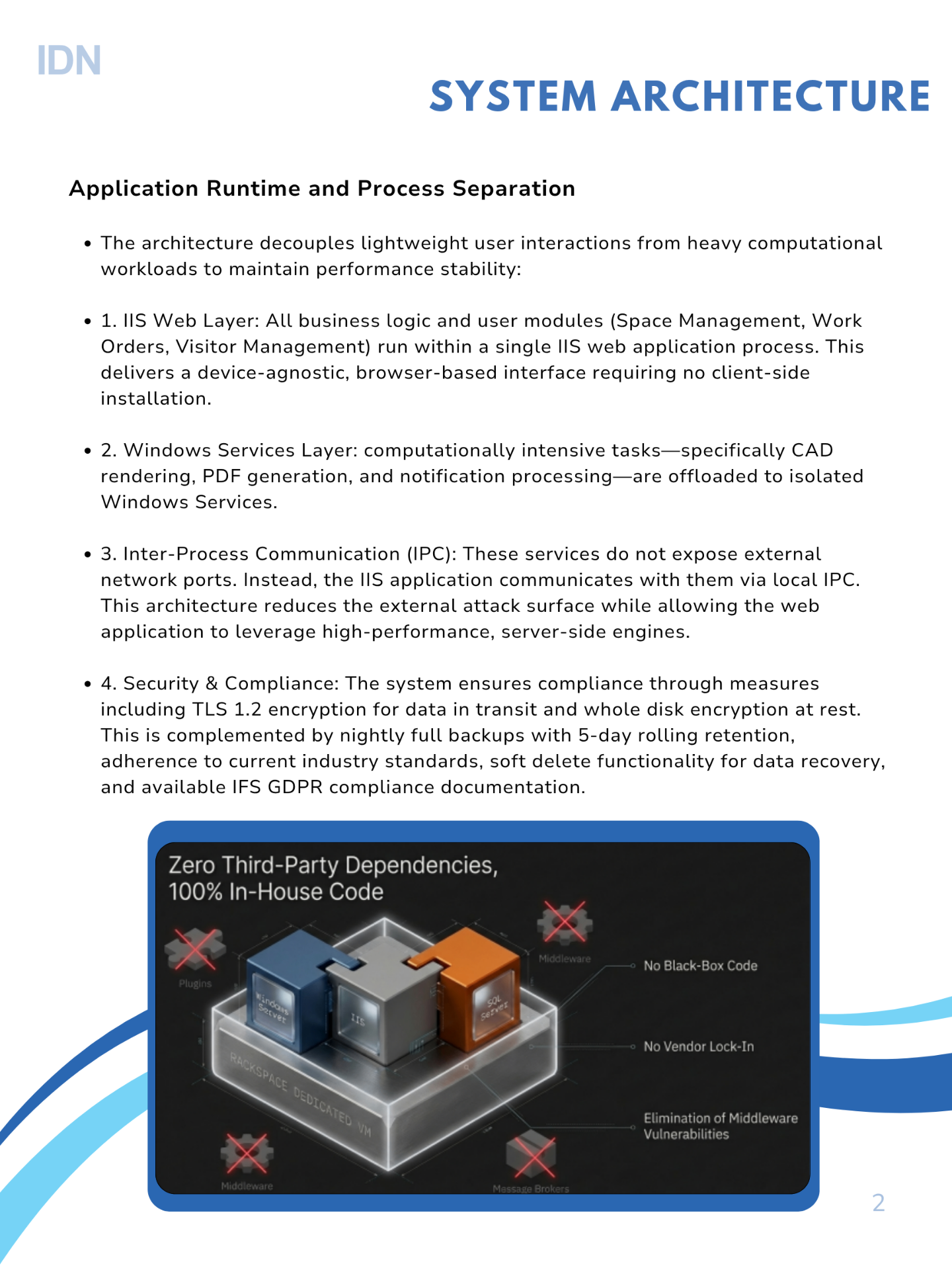
Zero third-party dependencies. 100% in-house code on dedicated Rackspace VMs.
One coherent stack
from silicon to agent.
A proprietary, cloud-hosted SaaS platform engineered with minimal third-party middleware. Every layer designed around the same semantic model, so context flows seamlessly between systems, people, and AI.
Applications
Web, mobile, BI dashboards, partner apps, and embedded experiences.
AI Agents
Copilots, autonomous workers, and natural-language interfaces.
Business Logic
Workflows, policies, rules engines, and automation primitives.
Open Building Schema
CorePlain-English relational core. 333+ tables, 8 entity domains.
Infrastructure Services
Storage, search, events, identity, observability, secrets.
Proprietary by design, isolated by default.
Core engines are developed in-house for performance and long-term control. Aside from the underlying Microsoft stack (Windows Server, SQL Server, IIS), all application components — CAD engine, notification systems, document generators — are custom-built. This eliminates reliance on external middleware or licensed vendors, ensuring full control over performance, security, and long-term supportability.
Infrastructure & Isolation
Dedicated hosting within Rackspace data centers. Unlike shared or containerized environments, each enterprise client is provisioned with a discrete Virtual Machine (VM) to establish a strict infrastructure isolation boundary.
Data Sovereignty & Schema
Single-tenant data architecture. Each client is assigned a fully dedicated SQL Server database — no row-level tenant tagging, no shared schemas, zero risk of cross-tenant exposure. 300+ tables with enforced foreign keys drive the UI at runtime.
Database Server
A dedicated Microsoft SQL Server instance handling storage, query processing, and database-level event triggers. Strictly isolated from direct client traffic.
Web Server
A Microsoft IIS instance serving as the sole ingress point for user traffic, hosting the application logic and routing requests.
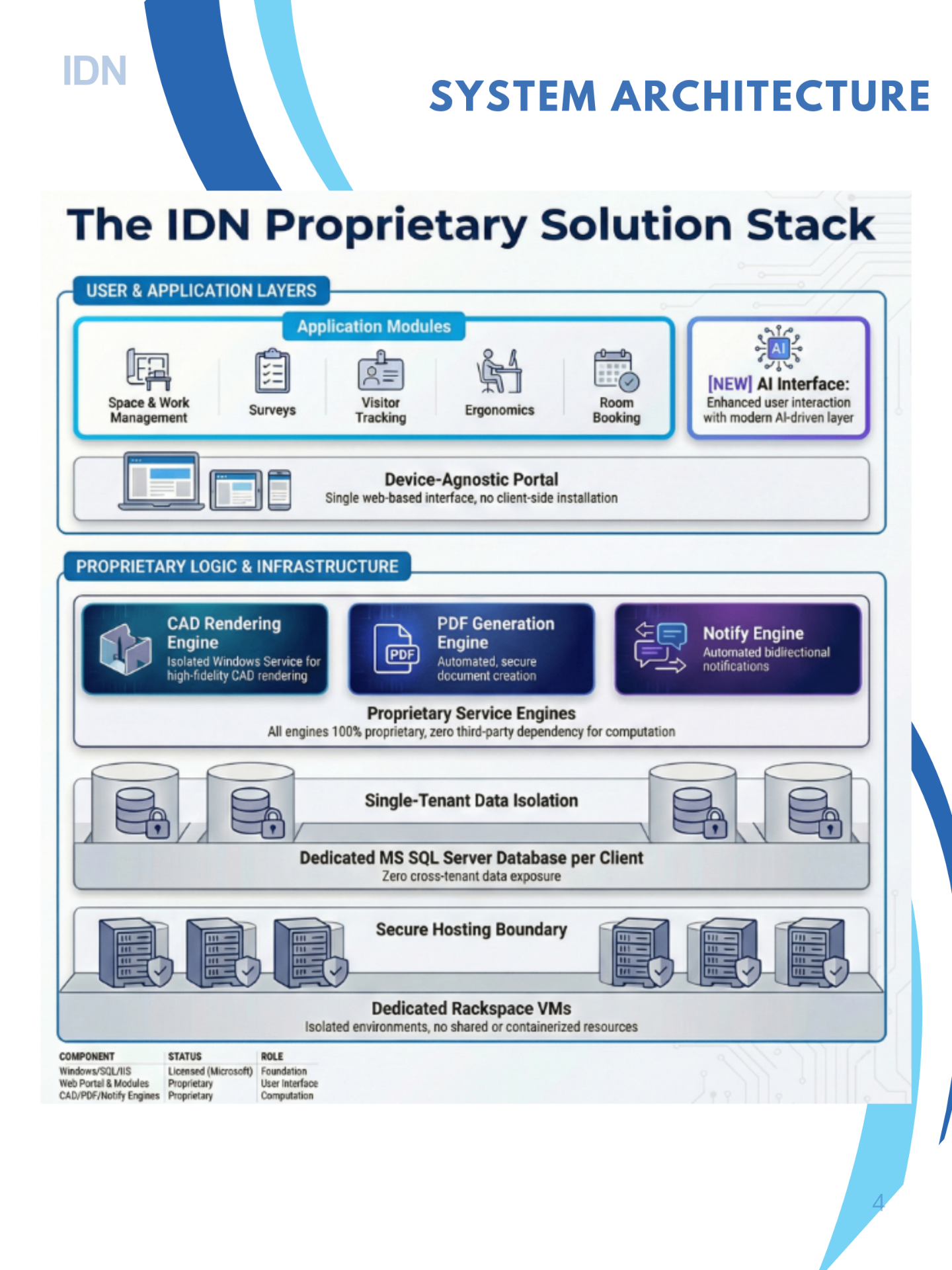
The IDN proprietary solution stack.
From the device-agnostic portal down to dedicated Rackspace VMs — a single-vendor, single-tenant stack with proprietary computation engines at every level.
Purpose-built engines, no black boxes.
Every computationally significant component is built in-house — from spatial rendering to notifications to integrations.
CAD Engine
Server-side spatial rendering engine that generates and edits facility blueprints. Graphics processed on the server and streamed to the browser — no plugins, no client-side CAD software.
Notification & Scheduling
Bidirectional engine for outbound alerts (Email, SMS) and inbound workflow automation (e.g. parsing emails into work orders). Database-level triggers drive event workflows without external polling.
Integration
Dynamic HR data feed with drag-and-drop, built-in API for pushing drawings and data outbound, scheduled HTTPS feeds from HR systems (e.g. Workday), and inbound move requests from platforms like ServiceNow.
- Dynamic HR Data Feed
- Built-in outbound API
- Scheduled HR data ingestion
- External request intake (ServiceNow, etc.)
Authentication
Enterprise Single Sign-On via SAML, OAuth/OIDC, and Active Directory, alongside a native authentication option.
RESTful API
External integration through a separately-secured RESTful endpoint with advanced access controls beyond standard authentication:
- Time Locks — restrict calls to specific operational windows
- Geographical Locks — limit access by regional IP origin
- IP Whitelisting — restrict to authorized systems only
IDN is a cloud-hosted SaaS platform built on minimal third-party dependency, leveraging the Microsoft stack to ensure strict infrastructure and data isolation through dedicated virtual machines and single-tenant databases. The system decouples its device-agnostic web interface from heavy computational workloads by offloading CAD rendering and notification processing to isolated server-side Windows Services.
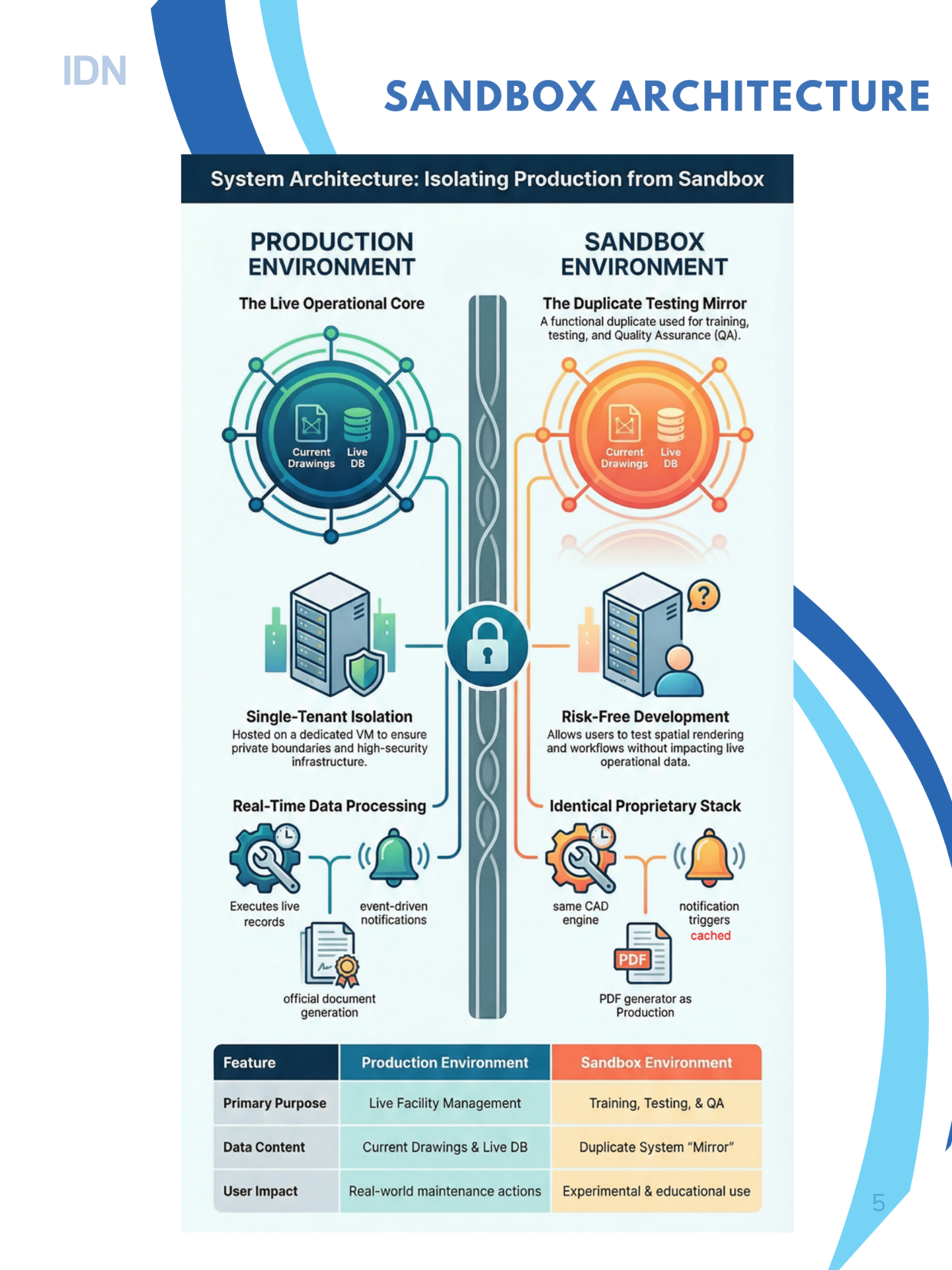
Production and sandbox, fully mirrored.
Every Enterprise client receives a functional duplicate of their production environment — used for training, testing, and quality assurance without risk to live operational data.
Production Environment
The live operational core
- Single-tenant isolation — dedicated VM ensuring private boundaries and high-security infrastructure.
- Real-time data processing — executes live records with event-driven notifications.
- Official document generation — audit-ready outputs from live data.
Sandbox Environment
The duplicate testing mirror
- Risk-free development — test spatial rendering and workflows without impacting live data.
- Identical proprietary stack — same CAD engine, same notification triggers (cached).
- PDF generator as production — parity in document output for QA validation.